BUSINESS NAMES, DOMAIN NAMES and TRADE MARKS: WHAT’S THE DIFFERENCE?

BUSINESS NAME

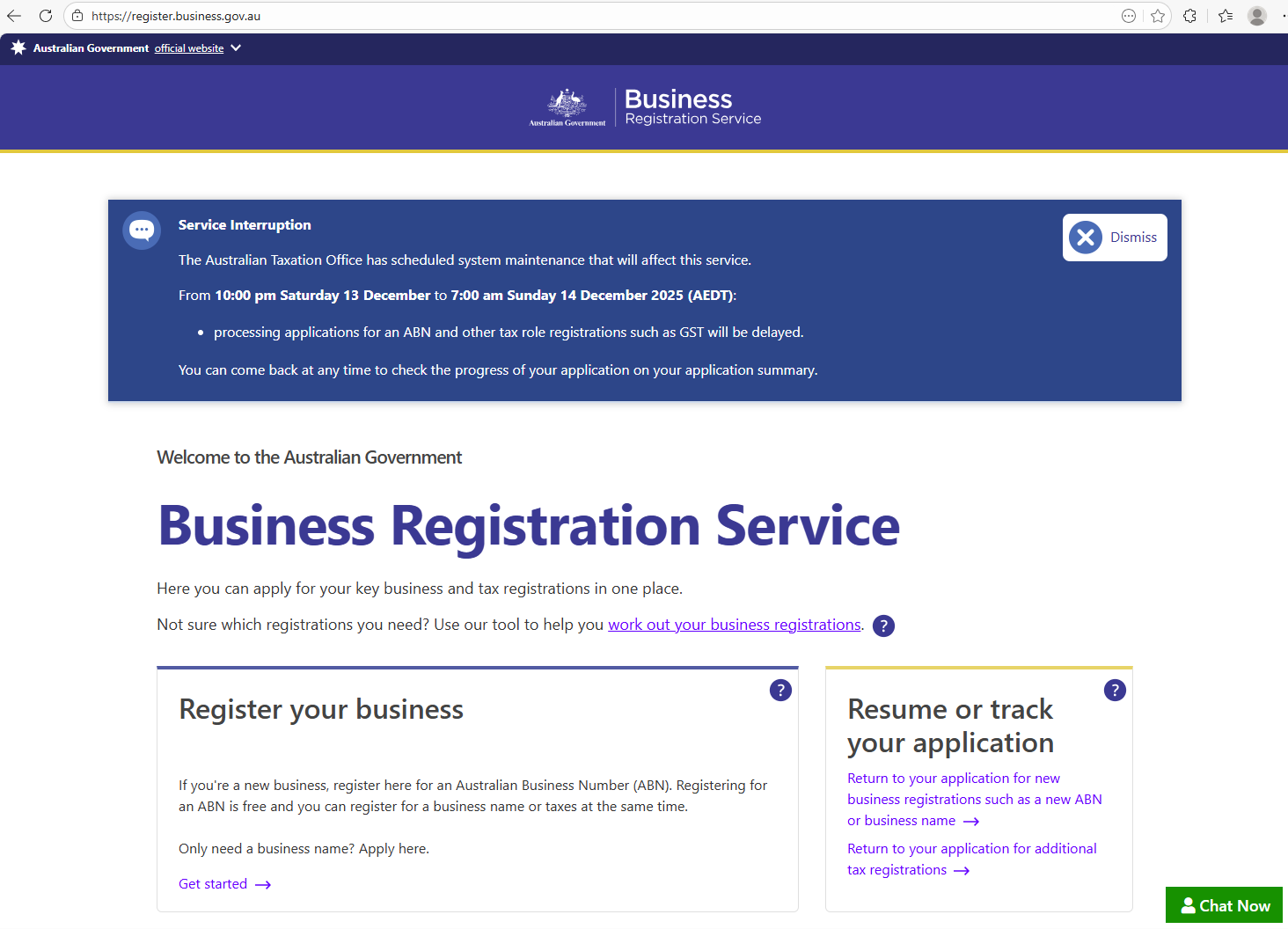
Business Registration Service

It is a (very!) common misconception that the registration of a business name (under the Business Name Registration Act 2011 (Cth)), company name or a website domain name confers some form of ownership or exclusive rights to the use of that name in Australia. It doesn’t!

Only if the name is registered as a trade mark does it confer such rights. Having a registered trade mark can provide legal protection for your business, its brand(s) and goodwill and gives you statutory rights to prevent another business from using the same or similar trade mark in conjunction with the goods and services of the same description. A registered trade mark can also be your most valuable marketing tool, as well as quite often an appreciating asset on you balance sheet.

Choosing a business name, or a domain name that infringes (inadvertently or otherwise) an existing trade mark can be a costly exercise. It could mean drawn out disputes, legal costs and possibly being compelled to cease using your business name amongst other matters – see below.

What is the point of registering a business name?

The Business Names register is administered by the Australian Securities and Investments Commission (ASIC).

The purpose of registering a business name is to ensure that consumers and businesses that you deal with are able to identify or ascertain who the operator or actual legal owner of the business is. Accordingly, businesses must either trade under its own name or a registered business name.

Registration also ensures that every business complies with the Business Name Registration Act 2011 (Cth). Registration is mandatory (with some exceptions) and it must be done before the business starts trading. Businesses who fail to register their business name can be fined.

Things to note when registering a business name

Be aware of the following that appears on ASIC’s website when you register a business name:
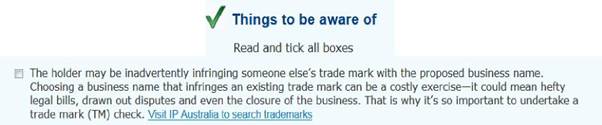
As a precaution, you should always check whether your business name may infringe a registered trade mark by conducting a trade mark search using the Australian Trade Mark Search function on IP Australia’s website, as well as an internet search for similar instances of the name. This is because the Business Names Register only alerts the registrant if the registrant is seeking to register a business name that is identical (an exact match) with another registered business name. It will not search the Australian Trade Marks Register for substantially identical or deceptively similar names.

If your registered business name is substantially identical with, or deceptively similar to a registered trade mark, it may be infringing that registered trade mark. Where an infringement has occurred, among the remedies available to the registered trade mark owner as we will briefly outline below, the registered trade mark owner may also apply to the courts to cancel your business name.

If the trade mark owner is successful, it will mean you have to trade under a new business name, change your marketing and advertising materials and signage, and lose the branding and the goodwill that you have built up under the old business name.

DOMAIN NAMES

https://www illustration image

What is a Domain name?

A domain name is your unique website address (or more specifically the Uniform Reference Locator (URL) on the internet (e.g. https://asic.gov.au, it is the online identity for your business. Modern technology and our increasing reliance on the internet means that domain names are important marketing tools to generate traffic for businesses.

A Domain Name is separated into various distinct components:

  • Top Level Domains (TLD), which are split into:
    • Country Code Top Level Domains (ccTLD) – for example, .au; .nz; .uk
    • Generic Top Level Domains (gTLD) – for example, .co; .com; .net; .gov; .edu
  • Second Level Domains (2LD) is situated immediately before the Top Level Domains, and commonly refers to the name of the organisation that registered the domain name; for example,
    ipaustralia.gov.au; or bmlegaladvisors.com.au
  • Third Level Domains (3LD) is situated immediately before the 2LD, and so on. For example,
    search.ipaustralia.gov.au

In Australia, the entity that is responsible for administering .au domains is .au Domain Administration Limited (ACN 079 009 340) (auDA). auDA has published a set of rules (.auDA Rules) under which a .au domain name can be granted. This includes, for example, that in order for an applicant to be granted a licence to use a .com.au or a .net.au domain name, the applicant must have, among others:

  • a commercial entity; and
  • the name applied for is a match of, or an acronym of, the person’s company name, business name, statutory name or personal name; or
  • a match of the applicant’s Australian trade mark; or
  • a match of or an acronym of:
    • a partnership to which a person is a partner; or
    • a trust of which the person is a trustee.

A third party cannot register a domain name that is an exact match of the domain name that you have already registered. However, a third party can still apply for a licence to a domain name that features the same 2LD but with a different gTLD.

Globally, the entity that is responsible for the administration of the Domain Name System (DNS) is the Internet Corporation for Assigned Names and Numbers (ICANN).

Domain Name Disputes

While outside of the scope of this article, briefly, it is important to note that if a dispute has arisen with the registrant of another .au domain name in relation to one or more of the .auDA Rules, using the .au Dispute Resolution Policy (auDRP) (which is intended to be a cheaper, speedier alternative to litigation with respect to a domain name) may be beneficial to resolving such a dispute. A panel of one or three members will arbitrate the matter and determine whether the domain name is to be “dropped” (in other words, made available on the open market), or transferred to another entity.

The auDRP is an adaptation of ICANN’s Uniform Dispute Resolution Policy (UDRP) which is also directed at resolution of disputes among domain name registrants internationally.

Infringement of Trade Mark

Similar to a business name, if your domain name infringes upon a registered trade mark, the trade mark owner may, among other remedies, issue a ‘cease and desist’ letter, demanding that you cease using the domain name. The trade mark owner can also commence proceedings against you for the tort of ‘passing off’ (briefly, where one party trades on the goodwill or reputation of another trader, causing that other trader loss or damage), or for infringing their registered trade mark; and may also initiate auDRP or UDRP proceedings against you.

TRADE MARK

Trade Mark TM

What is a Trade Mark?

Section 17 of the Trade Marks Act 1995 (Cth) defines a trade mark as:

a sign used, or intended to be used, to distinguish goods or services dealt with or provided in the course of trade by a person from goods or services so dealt with or provided by any other person.

In simpler terms, a trade mark is a “badge of origin”. It distinguishes between the goods and services of one trader from those of another.

A trade mark can be a word, phrase or letter in English or a foreign language, or a number, shape, aspect of packaging, picture, logo, or even sounds, smells, and a particular colour. So long as it is:

  • distinctive, as it is either
    • inherent ability to distinguish your goods or services from those of another; or
    • through use or other circumstances, the mark has acquired a distinctiveness such that the mark can distinguish between goods of one trader from another; or
  • not scandalous or contrary to law; or
  • intended to be used as a trade mark with respect to the claimed goods and services; or
  • not substantially identical with, or substantially similar to an existing trade mark and:
    • is used with respect to goods and services of the same description; or
    • that other trade mark has such a broad reputation that registration of your mark would be likely to deceive or cause confusion among consumers,

a trade mark is likely to be registrable.

A registered trade mark under the Trade Marks Act gives you the exclusive legal right to use, license and sell your goods and services using that mark in Australia.

Once registered, it is a balance sheet item and is an appreciable asset. When you eventually sell the business, the registered trade mark may add value to the sale.

Maintenance of a Trade Mark

However, unlike a registered business name, which only requires the payment of fees to maintain the Business Name on the register, it is also important to maintain the registration of the trade mark. In addition to paying renewal fees every ten years, it is also necessary to continue using that mark as a trade mark in conjunction with the trade in the goods and services claimed under that registration. There are different means by which a trade mark can be removed from the register.

Removal of a Trade Mark

Most commonly (there are other, less common grounds by which a trade mark can be removed from the register), removal of a registered trade mark can be due to non-use, or because the trade mark has become generic (if it is generally accepted in the relevant trade as the sign that describes the relevant good or service).

  • Non-Use
    If the trade mark owner does not use the mark for three consecutive years in conjunction with the goods and services claimed, it may be open to a third party to apply to IP Australia to remove your trade mark – either fully, or partially (with respect to only certain goods and services) from the register. If IP Australia decides to remove your trade mark for non-use, you will no longer have exclusive rights to use that trade mark, or in the case of a partial removal, your exclusive rights to use that trade mark with respect to those goods and services which are removed from your trade mark registration will cease.Use of the mark can include licensing to a third party to apply to goods or services, provided, however, that the trade mark owner must continue to maintain ‘control’ over the licensee’s use of that trade mark trade mark, for example, by having control over the products and services to which it is applied, including quality control, or having a right to review marketing materials prior to publication.

    It can also indicate financial control, for example, where the licensor is a parent company with more than 50% interest in the licensee, or where resources are shared between the licensor and licensee.

    In many instances, businesses may ‘park’ their IP in a holding company and licence the same to a trading entity. It is therefore important that a licence is carefully drafted to ensure that the licensor maintains ‘control’ over the use of the trade mark, or it may be liable to be removed for non-use.

  • Genericised
    If a trade mark has become generally accepted in the relevant trade as the sign that describes the relevant goods or services, it may become genericised. The owner of the mark will no longer have exclusive rights over that mark, even if it may remain on the register. In Australia, for example, Sanitarium lost the exclusive right to ‘GRANOLA’.Some tips on how to prevent “genericide” includes:
    • Use the ® symbol in conjunction with any use of your trade mark;
    • Always use a noun to describe your goods and services following your trade mark, for example, Kleenex® tissues, rather than Kleenex.
    • Never use your trade mark as a verb, e.g. “google it”; “hoover the carpet”.

Infringement of Trade Mark

Infringement of Trade Mark
Section 120 of the Trade Marks Act details the instances in which a registered trade mark can be infringed. For example, a person infringes a registered trade mark by using as a trade mark that is:
  • substantially identical with the registered trade mark; or
  • deceptively similar to the registered trade mark; and
with respect to goods and services of the same description, or in relation to unrelated goods and services if that registered trade mark is a well-known trade mark.

Penalties for Trade Mark Infringement

The courts may award relief pursuant to Section 126 of the Trade Marks Act 1995 (Cth) (“the Act”) as follows:
  • Injunction The court may grant an injunction, on any conditions the court thinks relevant. Under an injunction the registered trade mark infringer will be required to cease using the infringing name, image etc.
  • Damages or an Account of Profits The court may, at the option of the registered trade mark owner, grant damages or an ‘account of profits’.However, the court will not award damages or an account of profits to the registered trade mark owner if:
    • the alleged infringer has applied for an order (which is subsequently granted) that the registered trade mark is removed from the trade mark register (for example, because of non-use) in respect of the allegedly infringing goods and services; and
    • the court finds that the registered trade mark was not used in good faith by the registered trade mark owner in relation to those goods and services, during the period the registered trade mark was claimed to be infringed.
  • Additional Damages The court may grant additional damages if the court considers it appropriate by having regard to:
    • the flagrancy of the trade mark infringement;
    • the need to deter similar infringements of registered trade marks;
    • the conduct of the alleged infringer occurring after the trade mark infringement;
    • the conduct of the alleged infringer occurring after they were informed of the alleged infringement;
    • any benefit accrued to the alleged infringer as a result of the infringement; and
    • any other relevant matters.
  • Removal of Trade Mark In addition, the court may also order that your infringing trade mark, if it is found to be infringing on another registered trade mark, be removed from the register if your trade mark is also a registered trade mark.
  • Penalties for Parallel Importation Other penalties under Part 13 of the Act relate to goods imported into Australia which contain marks which are substantially identical with, or deceptively similar to an existing Australian registered trade mark. These penalties include the seizure, inspection and recall of goods which bear the infringing trade mark.

How do I register a trade mark?

You can register a trade mark online using IP Australia’s website. However, before applying for a trade mark, you should be clear as to the following:
  1. who the owner of the trade mark will be;
  2. what are the goods and services for which you are using, or you intend to use in conjunction with your trade mark;
  3. whether you meet the legal requirements; and
  4. whether the proposed trade mark is likely to infringe another registered trade mark.

Goods and Services

You will need to give careful thought to, and select the appropriate classes of goods and services from IP Australia’s list of 45 classes (34 classes of goods, and 11 classes of services). Within those classes, there are a number of goods and services from which you may pick to accurately describe the goods and services for which you are seeking the protection of a trade mark. When considering what classes of goods and services you should register, think not only about the exact nature of your business now but also in the future. Ask yourself:
  • Where do you derive your business income?
  • What is the nature of your business?
  • What are you known for by your customers?
  • What products or services does your business provide?
  • What products or services may your business intend to provide in the short term future (i.e., within the next two years)?
If your claims are too broad, it increases the chances that all or some of your claims may overlap with an existing trade mark, leading to IP Australia rejecting the application, or if it accepts your registration that a third party may later allege that your trade mark is infringing on theirs. It would also be open to a third party to make an application to IP Australia to remove your trade mark for non-use with respect to the goods and services for which you are not using the trade mark.

What gives the greatest protection?

To achieve the best protection for your business’ brand you should seek registration of trade marks for both its name and logo. However, if you are unable for any reason to apply for registration of both your name and logo, the name itself will generally provide greater scope of protection. This is because registration of your name gives you exclusive trade mark rights to use that name (including the right to take action for trade mark infringement if a third party uses a name that is substantially identical with, or deceptively similar to, your trade mark), while registration of your logo only grants exclusive trade mark rights over that specific logo. If the owner later changes the logo, it will be necessary to apply for a new trade mark application in order to obtain trade mark rights to that new logo (subject to IP Australia approval). Conversely, a name may lack the distinctiveness required to be registered as a trade mark, which is where applying to register the logo as a trade mark may be more advantageous than applying to register the name by itself. From the above, it is evident that when applying for a registered trade mark you must carefully balance the scope of the protection you will receive against your prospects of having an application approved. This process can be tricky, tedious and time-consuming, and if it is not done correctly, the registered trade mark may not be effective against another trade mark if you fail to select the correct classes or goods and services. We suggest that you seek legal advice and assistance to ensure that the registration process is done properly. We can assist you with the registration process as well as other matters relating to obtaining and maintaining a trade mark. Please contact us for further information.